Mitch's one man show at the Fringe festival got rave reviews from lots of folks including the New York Times. I enjoyed it a lot myself, and now it will be on the YouTube. Here is the trailer.
www.triumphoftheunderdog.blogspot.com
Wednesday, September 17, 2008


Tuesday, September 16, 2008
Jason Powell on Uncanny X-Men #166
[Jason Powell continues his issue by issue look at Claremont's X-Men. For more in this series see the toolbar on the right. This is a particularly good post: I was not a big fan of this issue, as I was annoyed with the whole magic space whale stuff, but I think Jason has changed my mind.]

“Live Free or Die”
Classic X-Men #13b, “Lifesigns,” showed Claremont dabbling in a bit of philosophy about nature, suggesting that there was a karmic balance to the world symbolized by the dichotomous relationship between dolphins – symbols of life, intelligence, the future, etc. – and sharks, who represent death, instinct and the primordial past.
That story, as it turns out, is a mirror for this one, which echoes that philosophy on a cosmic scale via Claremont’s conception of two races, the Acanti – who swim through the cosmos in schools and communicate with each other in song – and the Brood, described in issue 162 as perfect killing machines.
In the middle of this dichotomy are the X-Men, who in this climactic double-sized episode choose between a path of darkness and death, and one of life and light. The former is incarnated in the notion of a suicide run against the Brood; the latter, an optimistic rescue attempt that will save the Acanti’s racial “soul.” The choice of course is no choice at all, but Claremont’s writing is fluent enough at this stage that the contrivances required to build to that moment are convincing, and the X-Men’s decision to make a play for the Acanti’s salvation seems genuinely redemptive.
Claremont’s precise plotting is in top form in “Live Free or Die,” which brings together elements of the long-running Brood arc that seemed at the time arbitrary and/or simply stylistic flourishes done for their own sake. The Acanti were not named before now, but issue 162, the one that started the Brood saga’s final narrative domino chain tumbling, established (in Cockrum’s amazing double-page spread) that the corpse of one of the giant whale-ships served as the capital city of “Sleazeworld.” Wolverine’s long ordeal in the heart of the corpse in Uncanny 162 seemed at the time simply a good milieu to get across that story’s Wolverine-as-ultimate-tough-guy motif. Here, in a well-orchestrated revelation, that earlier adventure proves to have been a key plot point, shrewdly disguised: the very place where Wolverine faced the worst trials is the location of the Acanti soul.
The long climactic sequence, in which the X-Men return to Broodworld to liberate the soul, is superbly constructed. Though artist Paul Smith’s greatest strength is in quietude, he proves versatile enough to craft dynamic action scenes here, and Claremont’s text – crisply dressed in Tom Orzechowski’s letters – glides along Smith’s smooth lines effortlessly. To give the whole thing an extra layer of gravitas and significance, Claremont adds some clever chimes with the past: the sudden rescue by the Starjammers is an effervescently delightful homage to the climax of Cockrum’s first run on X-Men (signaling perhaps that though he didn’t quite make it to the climax of the Brood story he inaugurated, the spirit of Cockrum’s creativity still informs these proceedings). Meanwhile, the recreation of the Cyclops/Wolverine enmity is a downright brilliant stroke, cluing both the readers and Logan that Cyclops is a traitor – the panel in which Wolverine rips off Scott’s visor to reveal alien eyes beneath being a deliciously visceral payoff.
(The panel that immediately follows offers a great visual as well, as Scott’s eye beams are shown firing in two segmented lines from his queer eyes: Cyclops suddenly rendered non-Cyclopean.)
The ending of course is a deus ex machina, but is meant to operate more on a symbolic level. Part of the point of the Brood saga was to test the X-Men’s moral center, to see whether their oft-repeated “X-Men don’t kill” refrain could stand up in the face of a completely unredeemable enemy like the Brood. The X-Men – Storm in particular – find their morals strongly tested, and here, in their choice between life and death as respectively represented by the Acanti and the Brood, they all chose life. Even Wolverine, whose moral compass is separate from the others, was tested. Lacking any compunctions about killing the Brood, he faces the choice of killing the other X-Men once they are infected with Brood embryos.
The X-Men thus passing their moral test, the Acanti soul redeems them, and the Brood eggs (symbolic of their collective immoral urges) are expunged. The entire thing is not subtle, but by tying the conflict of “Live Free or Die” into a larger theme, the entire story is elevated beyond conventional superheroics. Carried by Paul Smith’s sympathetic pencils (and Bob Wiacek’s inks as well), the theme is carried off surprisingly well, conveying a palpable sense of genuine redemption.
X-Men #166 marks another milestone as well, being the climax to the X-Men’s superheroic phase. Having explored to the hilt with Cockrum and Byrne the X-Men’s story potential inside the superhero genre, and armed now with an artistic collaborator capable of new levels of psychological depth and complexity, Claremont is prepared now to launch into a more nuanced style of storytelling. Hints existed in earlier issues of the potential for this change (the new back-story for Magneto being the most significant harbinger of darker subject matter, and the tone and style of the vastly underrated Uncanny #160 pointing the way), but the full transformation had yet to occur. Paul Smith’s addition to the creative team was just the catalyst Claremont required, and with the climax of the Brood story here (followed by a tying off of loose ends next issue), Claremont will change the Uncanny X-Men into almost an entirely new comic book.
Trivia: That the new X-Men’s superhero phase ends with #166 is a striking coincidence of numbering, given that the Silver Age X-Men were cancelled with #66. In a strange way, Uncanny #266 will mark a similar milestone as the first appearance of Gambit – the first Claremont X-character deliberately devoid of any semblance of internal psychology, conceived only as an agglomeration of “cool” surface traits.
Scott on the Office: Jim and Pam
[Guest blogger Scott, on the Office again. I make a comment below.]
(Ironically, the only clip of this I could find on youtube was a fan-made montage the sets the moment to music… there are, like, dozens of these on youtube that chronicle the Pam/Jim love story)
One of the things that I picked up on about the Office from our discussions on this blog that I found was one of the things that I love about the show is its emphasis of 'small perfect moments' over big dramatic moments (the latter often being ridiculed by the show). Perhaps the all-time greatest example of such a moment is in the final minutes of the Season 3 finale. This is the moment of the big 'breakthrough' in the Pam and Jim relationship. In any other sit-com it would have been handled thusly: after a big dramatic outpouring between two characters in which their feelings are revealed, one of the two, out of embarrassment or frustration, runs off, only to return at episode's end when we find them standing outside in the middle of a rainstorm and, finally, after 2 or three seasons Rachel and Ross embrace in a passionate kiss to the strains of "With Or Without You"…. or something like that… cue the Kleenex.
As always, the Pam and Jim relationship is more subtle. In the Season 3 finale, Jim, his current love interest, Karen (who, unlike most sit-com 'other women' is actually a fully realized and likeable character) and Michael are all off in New York interviewing for an opening at the corporate office. In the final few minutes of the episode, Pam's 'interview' piece where she wishes Jim well and hopes for the best while regretting that they 'never got the timing right' is inter-cut with Jim's 'job interview' during which he opens his resume to discover a 'good luck' note from Pam. Just as we are thinking that we will have to wait yet another season for the relationship to be resolved, Jim interrupts Pam's interview and we get the following exchange:
Jim: Are you free for dinner tonight?
Pam: Yes.
Jim: Alright… then it's a date.
Then, in an award winning moment on Jenna Fischer's part, she turns to the camera, asks the interviewer to repeat the question and smiles without saying a word as we see just a hint of the sparkle of tears in her eyes. There was no big swell of music… no standing in the rain…. But, you know what? I still found myself reaching for the Kleenex.
[I am always caught between liking the best stuff and dismissing the junk, but then having to acknowledge that without the junk for support the good stuff would not work. Case in point: that scene between Jim and Pam at the end of season three works because of the understatement -- but my criteria for understatement, as Scott suggests, has been determined by all the lame sitcoms over the years. The scene works in large part because I can see so clearly in my mind's eye how all other programs would have botched it.
Comic book tradition reached a level of density to support complex revisionary stuff like Dark Knight Returns and Watchmen. TV does not seem to be, except rarely, a very allusive medium, but you can still see shows like the Office and the Wire building success by simply avoiding what we all know to be bad storytelling, but that we have just lived with for so many years.]
Monday, September 15, 2008
Maxx (5/12 Youtube Clip)
Notice, in the scene with Sarah and her mom, how Sarah is silhouetted in black with white glasses -- that is one of Miller's signature visuals, invented for a Batman shadow with white eyes. The Maxx sitting next to her -- the superhero hilariously doing nothing -- helps us see the connection to the genre through his own, earlier, rain soaked monologues. In the story within the story the carjackers -- Izz -- are dressed like Miller's mutant punks in Dark Knight Returns.
Check the parody of dark monologues -- practically a meta-monologue (in the RAIN no less) -- with an admission of total failure at the end: "If dad had to shoot somebody, why couldn't it have been her. Did my saying that shock you? Good. Writers are supposed to shock people. We say witty and uncontrolled things that rip the shroud off a decaying society and expose it for what it is. Well, thats the idea anyway." Gaiman gets tossed into the mix as well, as Sarah makes fun of her classmates that are "necro-nerds and sand-freaks" that is to say fans of Gaiman's Death and the Sandman, complete with haircuts to match. "Death is not some cute chick."
Always interested in psychoanalysis, even of the dime store variety, Kieth loads Sara up here, with a father out in a "gone postal" murder suicide and a hippe chick mom -- of exactly the sort Camille Paglia (Julie Winters' hero) would HATE. Julie and Sara's mom are friends, but rehash a Steinem-Paglia battle when they get together. In counseling, Sarah sheds more light on Julie than Julie sheds on Sarah. The use of this context for character development will become quite popular in the Sopranos and imitators like Grosse Pointe Blank.
There is also a cute joke as Sarah compliments herself on her ability to foreshadow just before she says the line "My father is gone."
"I could feel the gun in my hand. But more importantly I could feel the sweet hot hatred my dad must have felt," she says as Jimmy breaks her heart. She does nothing with the gun of course -- she is a writer, not a post-Miller vigilante. Using a short story within a larger superhero narrative -- putting Sarah alongside the Maxx -- Kieth is doing what psychoanalysis is supposed to do: he is exposing the subterranean origins of surface behavior, as he demonstrates that the silhouetted comic book figure monologuing dark thoughts in the pouring rain is little more than a teenager who someday wishes to be a writer -- but it NOT one yet.
Sunday, September 14, 2008
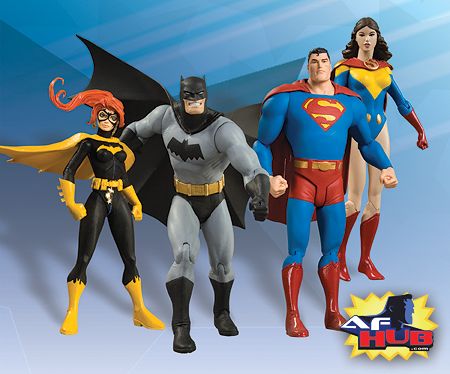
ALL STAR WEDNESDAY (EDIT: NOT REALLY)
Out Wednesday (EDIT: Batman is not out on Wednesday, messing up the whole post -- sorry):


glory glory glory
Subscribe to:
Posts (Atom)


 Posts

