Monday, January 08, 2007

Grant Morrison’s New X-Men 115

[This post is part of series of posts looking at Grant Morrison's New X-Men run issue by issue; click on the "New X-Men" label at the bottom of this post to read all the entries.]

The Wolverine cover is great.
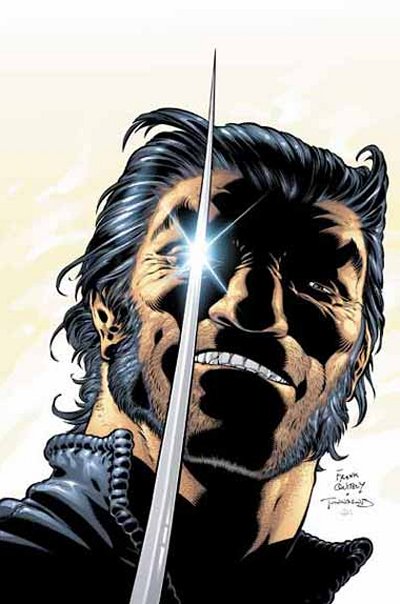


Like the first, and the next few covers, Morrison and Quitely are after a magazine look, and if Wolverine were on the cover of GQ this is what it would look like. We get one more glamor shot of everyone's outfits with the first two page spread, as Quitely gives us the whole team lineup in a single static image with labels -- this book really is all about the clothes, which I love.

http://digilander.libero.it/dicarta/Fumetti/Comics/New_X-Men/wolverine03.jpg

Morrison, in an effort to rehabilitate the character, even gives Cyclops the eternal boyscout some cool (as well as nodding to continuity): as the plane is going down he says "Relax, I've survived more jet aircraft crashes than any other mutant. Insurance takes care of everything." Wolverine says to him "You know what I admire most about you Summers? Your icy calm lunacy under pressure." "Call me Cyclops" he replies. Quitely's images of the character support this aim: even when his visor shatters, it is a thing of beauty in suspension.

Cassandra Nova's bony hand pushing though Trask's face as if it were a mask is a terrifying image, especially because her other hand and her body language suggest seduction. "Do you want to know the real message of evolution?" she says "All life ends up as manure" -- which is true and a great point to make in a book where evolution is the central concept. No more of Apocalypse with his giant "A" belt crying about making everyone strong or dead.

I know Cyclops's ruby quarts contact lenses bothered people but why the hell not have them -- it's not like they were a major part of the plot and that image of his visor shattering makes it worth it. As for his mercy killing of Ugly John being out of character -- it is a fair point from longtime fans but the payoff is an X-Men book that is genuinely surprising, which is a good trade, I think.

The image “http://xmen.dreamers.com/images/comics/usa/nxm/Untitled_1.jpg” cannot be displayed, because it contains errors.

In the comments to my discussion of the previous issue Ping makes the important point that Morrison and Quitely have made sentinels genuinely scary; they are disturbing and weird even though they seem to derive from the Jamie Lee Curtis movie Virus. Morrison brings the classic design back in his final arc (and calls it a classic) but for now giant bugs are fantastic. The destruction of sixteen million mutants in this issue is breathtaking, though I suspect that this is an editorial decision -- Joe Q said for years he wanted to decrease the mutant population to properly return to the "minority" theme of the book, the X-Men as a metaphor for persecuted outsiders; this just wasn't dramatic enough to stick, so House of M came along years later. If this was what Marvel wanted Morrison turned out to be a very bad choice on a number of levels, since he tried to get the X-Men away from "identity politics" -- rather than reestablish old themes he wants to inject new ones, like what it really means to know you are here to inherit the earth from a dying species. On every level this book is being re-imagined: design (cool clothes, the Beast, the sentinels), characters (Cyclops kills), concept (they are not superheroes), theme (Post-humanism rather than identity politics). Powerful stuff, and flawlessly done two issues in.

Friday, January 05, 2007

Free Form Comments

Say anything you want here, including shameless self promotion, anonymous criticism, and random thoughts.

All I want to do is direct anyone who wants to read my reviews of All Star Superman and Civil War to the comments section of yesterday's posts.

Thursday, January 04, 2007

Comics Out 4 January 2006

A good week this week: Matt Fraction and Ariel Olivetti's Punisher War Journal #2, Mark Millar and Steven McNiven's penultimate Civil War issue, and the cream of the superhero crop, Grant Morrison and Frank Quitely's All Star Superman #6.

Also, unrelated, the trailers for Quentin Tarantino and Robert Rodreguez's Grindhouse is up, as is the trailer for Ocean's 13; just plug them into youtube.

I will review the comics in the comments as soon as I get my hands on them, and you should too. As usual review, recommend, discuss.

I am off to teach the first day of my Kill Bill class. My head is bursting from knowing far too much about that movie right now.

Wednesday, January 03, 2007

Grant Morrison’s New X-Men 114 (Part Two of Two)

[This post is part of series of posts looking at Grant Morrison's New X-Men run issue by issue; click on the "New X-Men" label at the bottom of this post to read all the entries.]

Morrison wastes no time making the book his own. The Beast is redesigned – for good or ill it lets you know right of the bat nothing is sacred and everything can change, an exhilarating feeling to get from an X-Men comic book mired in years of unchanging continuity. Plus we get real banter: “Soda?” “Diet please.” “Diet? You weigh six hundred pounds.” “So? Do I want to get fat? I do a lot of leaping around.” We get Morrison at his unhinged best, when the Beast says “I feel like a Hindu sex god, Jean.”

Cerebra is clearly explained and elegantly designed, as is the X-Jet, with a sensibility not unlike the WE3 armor.


The design for Ugly John, as I mentioned in my book, is taken from an Australian Skiing magazine; Quitely uses hip sources even when going for ugly.

The image “http://www.marvunapp.com/Appendix3/uglyjohnxm2.jpg” cannot be displayed, because it contains errors.
With the Tommy Hilfigure uniforms the whole concept is re-imagined from the ground up: Morrison goes so far as to boldly assert that the X-Men never were superheroes, and thus should dress accordingly.
http://xmen.dreamers.com/images/comics/usa/nxm/xsuic.jpg
Morrison makes the whole concept dangerous again, and to mark the occasion gives Xavier a gun. Those who objected this being out of character missed the point: for Morrison the gun less of a steel weapon and more of a metaphor for violent change, which is why the final cover of the Invisibles is a hand with a gun.

The very first page of Morrison's run shows Wolverine ripping up a sentinel and Cyclops dryly remarking “You can probably stop doing that” – it is an indictment of decades of repetitive, redundant X-Men continuity. Just as the book opens with a metaphor for time past it closes with a metaphor for time future: Cassandra Nova says “imagine self made sentinels, using spare parts to evolve themselves into more effective forms.” The X-Men have always been about survival and Morrison wants to make them survive by using the past -- often piecemeal -- to evolve the book into a more effective form. This first issue is an incredibly strong start.

Tuesday, January 02, 2007

From Ernest Vincent Wright's Gadsby (Commonplace Book)

If youth, throughout all history, had had a champion to stand up for it; to show a doubting world that a child can think; and, possibly, do it practically; you wouldn’t constantly run across folks today who claim that “a child don’t know anything.”A child’s brain starts functioning at birth; and has, amongst its many infant convolutions, thousands of dormant atoms, into which God has put a mystic possibility for noticing an adult’s act, and figuring out its purport.

Up to about its primary school days a child thinks, naturally, only of play. But many a form of play contains disciplinary factors. “You can’t do this,” or “that puts you out,” shows a child that it must think, practically or fail. Now, if, throughout childhood, a brain has no opposition, it is plain that it will attain a position of “status quo,” as with our ordinary animals. Man knows not why a cow, dog or lion was not born with a brain on a par with ours; why such animals cannot add, subtract, or obtain from books and schooling, that paramount position which Man holds today.
You may feel that that that little passage, the first two paragraphs of Ernest Vincent Wright's Gadsby (1939),was not at all remarkable. In terms of content you would be right. But Gadsby is more than a coming-of-age story. It is a 50,000 word novel written entirely without the use of the letter E. Check those paragraphs again: no letter E anywhere. He wrote a novel avoiding all words that contained the letter E, the most common letter in the English language, five times more common than any other. He literally removed the "E" key from his typewriter, just for the fun of it. That means no verbs with an "ed" ending, no numbers between six and thirty, and very few pronouns since "he" "she" "they" "them" "their" "her" "herself" "myself" "himself" and "yourself" are all right out. The name of this kind of experiment, if you care to know, is "lipogram." The whole novel is available online for free: just click here, if you want to check if he cheated. (He didn't).