The only comic book I picked up this week was Jeff Smith's Shazam! The Monster Society of Evil. I like Jeff Smith, I guess, but this lost me in the same way that his Bone did: it is sweet and the art is clean and nicely designed but I don't really see what all the fuss is about. Especially since Grant Morrison and Frank Quitely are doing a much better aw-shucks hero in All Star Superman -- a book in which our sweet hero, instead of being mired in nostalgia, keeps slamming up against forward-looking sci-fi madness, shockingly well-designed creatures, and the brilliantly characterized, realistic and frightening Lex Luthor. Someone is more than welcome to explain to me the wonder of Jeff Smith; I am open to learning what it is about this guy that gets people so excited.
In comics news, Joss Whedon is off the Wonder Woman movie, for no reason other than creative differences, basically. That is sad, but there is good Joss Whedon news: Newsarama got a hold of a preview copy of the first issue of next month's Joss Whedon written Buffy comic book (which is being unofficially referred to as "Season 8"), and gave it a great review. So something to look forward to, for those of us who are Whedon people.
Also Newsarama has a preview of the new Grant Morrison Batman issue, which it says is out today, but I didn't see it. I seem to remember this happeneing before.
Review, Recommend, Discuss.
Wednesday, February 07, 2007


Tuesday, February 06, 2007
From The King James Bible (Commonplace Book)
"Wherefore I say unto you: all manner of sin and blasphemy shall be forgiven unto men: but the blasphemy against the Holy Ghost shall not be forgiven unto men." (Matthew 12:31)
"But he that shall blaspheme against the Holy Ghost hath never forgiveness, but is in danger of eternal damnation." (Mark 3:29)
What is the sin that shall not be forgiven? Nobody knows, though footnotes to the bible, which conflict each other, try to make people feel like this passage is not something believers should worry about. It is all quite obscure; and that's an area where you want a lot of obscurity -- on the subject of the secret crime against god that cannot be forgiven. One of my favorite bits in the bible.
Monday, February 05, 2007
Grant Morrison’s New X-Men 119
[this post is part of a series of posts looking at Grant Morrison's New X-Men; to read the rest of the posts, just click the New X-Men label at the end of this post.]
In the comments to my post about New X-Men 118, Ping made a very sound objection: I have been complaining that Morrison abandoned his call – visible in the first three issues and the manifesto – for pop-sexy X-Men; a work should be judged on its own merits, and since Morrison has left pop-sexy behind, I should too. Otherwise I will be like the person that complains that the Sopranos is a poor role model for children, as if the show is attempting to be a good role model for children and failing miserably.
But I can’t drop the pop-sexy X-Men idea because Morrison has not yet properly abandoned it. It still hovers around spoiling whatever direction he wants to replace it with (possibly the virtues of freaky, ugly, useless mutant children). Morrison has not changed directions – he has adopted a new direction in addition to the old one, and the two are pulling each other apart. The evidence is the juxtaposition of the cover for 119 and its interior.
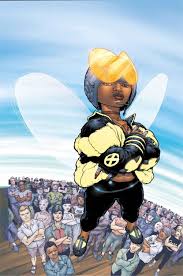
The cover is Quitely at his fashion cool best: Angel looks like a hip-hop star – her name is on her helmet in graffiti, she has at least eight rings on, and a fantastic pair of shoes to go with the outfit. She is confident, powerful, and hovers over a mass of normal and freaky people she has either left behind, or who stand with her in solidarity.
In the issue Kordey – whose vastly inappropriate ugly art style I have already blogged about – will draw her vomiting on her food in a diner while she bitches like the worst kind of high school girl and crashes into stuff. At the time I thought the cover was a vision of what she would become in the course of Morrison’s story, but in retrospect we know she will never wear that outfit or stand that cool. My objection is not just that the art in the issue makes everyone look horrible and crummy – it is that the cover looks so cool, and the issue – like the run – breaks under the stress of violently conflicting artistic temperaments.
Mr. Sublime is still a silly villain -- giving Emma a signed copy of his book as an insult is just dumb -- but Morrision does give him two brilliant lines in the same scene: he says to Emma “maybe we could split you into living shards and turn you into some kind of kinky chandelier” and “liquid diamond lipstick: heck of a good name for a band.” Sublime setting off Cyclops’s visor causing it to shoots the crotch of a statue of David, is juvenile and lame, but the scene where Jean feels the presence of something “crawling around the edges of our lives” is haunting, simple, and powerful. Morrison writes a beautiful and sad story for the guy who owns the diner – whose wife was killed in childbirth delivering a baby with mutant spikes – but also writes a very strange moment where Jean calls the police when the U-Men attack. Really? The one woman army calls the cops? Who will defend the school with, what, guns (tear gas won’t work since the guys are in self contained suits)? And, in a repeat of the end of last issue, we end on a bizarre anti-climax, the U-Men attacking the school led by Jean Grey (who Sublime dismisses as “one uppity redhead”): we have not established the U-Men as nearly scary or powerful enough to justify our worrying about Jean Grey for the next 30 days, and Sublime’s pointless overconfidence here does not help. The art pulls in two directions (one awful), and Morrison’s writing runs hot and cold.
In the comments to my post about New X-Men 118, Ping made a very sound objection: I have been complaining that Morrison abandoned his call – visible in the first three issues and the manifesto – for pop-sexy X-Men; a work should be judged on its own merits, and since Morrison has left pop-sexy behind, I should too. Otherwise I will be like the person that complains that the Sopranos is a poor role model for children, as if the show is attempting to be a good role model for children and failing miserably.
But I can’t drop the pop-sexy X-Men idea because Morrison has not yet properly abandoned it. It still hovers around spoiling whatever direction he wants to replace it with (possibly the virtues of freaky, ugly, useless mutant children). Morrison has not changed directions – he has adopted a new direction in addition to the old one, and the two are pulling each other apart. The evidence is the juxtaposition of the cover for 119 and its interior.

The cover is Quitely at his fashion cool best: Angel looks like a hip-hop star – her name is on her helmet in graffiti, she has at least eight rings on, and a fantastic pair of shoes to go with the outfit. She is confident, powerful, and hovers over a mass of normal and freaky people she has either left behind, or who stand with her in solidarity.
In the issue Kordey – whose vastly inappropriate ugly art style I have already blogged about – will draw her vomiting on her food in a diner while she bitches like the worst kind of high school girl and crashes into stuff. At the time I thought the cover was a vision of what she would become in the course of Morrison’s story, but in retrospect we know she will never wear that outfit or stand that cool. My objection is not just that the art in the issue makes everyone look horrible and crummy – it is that the cover looks so cool, and the issue – like the run – breaks under the stress of violently conflicting artistic temperaments.
Mr. Sublime is still a silly villain -- giving Emma a signed copy of his book as an insult is just dumb -- but Morrision does give him two brilliant lines in the same scene: he says to Emma “maybe we could split you into living shards and turn you into some kind of kinky chandelier” and “liquid diamond lipstick: heck of a good name for a band.” Sublime setting off Cyclops’s visor causing it to shoots the crotch of a statue of David, is juvenile and lame, but the scene where Jean feels the presence of something “crawling around the edges of our lives” is haunting, simple, and powerful. Morrison writes a beautiful and sad story for the guy who owns the diner – whose wife was killed in childbirth delivering a baby with mutant spikes – but also writes a very strange moment where Jean calls the police when the U-Men attack. Really? The one woman army calls the cops? Who will defend the school with, what, guns (tear gas won’t work since the guys are in self contained suits)? And, in a repeat of the end of last issue, we end on a bizarre anti-climax, the U-Men attacking the school led by Jean Grey (who Sublime dismisses as “one uppity redhead”): we have not established the U-Men as nearly scary or powerful enough to justify our worrying about Jean Grey for the next 30 days, and Sublime’s pointless overconfidence here does not help. The art pulls in two directions (one awful), and Morrison’s writing runs hot and cold.
Friday, February 02, 2007
Free Form Comments
All off topic posts go here: random questions, thoughts, anonymous criticism, suggestions, self-promotion (if you have a blog tell people what you have been writing about), announcements, requests to be added to the blog-roll, whatever. If you read but do not comment, introduce yourself here and start commenting.
Thursday, February 01, 2007
Brad Winderbaum's Satacracy 88: Episode Six
The new episode of Satacracy 88 is up on itsallinyourhands.com; check it out (link on the right), vote, then come back here for the commentary.
This sixth episode of Satacracy has debts to Batman: Tales of the Dark Knight, Buffy the Vampire Slayer (a sixth season episode Brad has never seen), and plays with material from Nightmare on Elm Street in a fun way (objects from dreams can come back with you). But the influence I want to focus on in this post is the origin of all three.
Like the best science fiction (Dark City, The Truman Show, the first Matrix film, the Invisibles), Satacracy has found its Gnostic heritage. Creation is a flawed and dangerous illusion, a horrific prison world, and an inner light is your only guide, against all other influences. Even those we are closest to, those we want to trust, may be part of the nightmare, soldiers sent to keep us in chains with kind words and good intentions. Just as the Gnostic messiah -- or messiahs, as there are more than one -- enters the world of the dream (the world where we live), where he may become ensnared both physically and psychically and forget his true mission, Angela enters a dream with a mission she is in danger of forgetting. It is important that her most dangerous foes are kindly and familiar. This is how they come for you.
The casting of Max Ghezzi as Dr. Johnson is perhaps the best casting yet. He looks almost nice, almost right, but something about him is subtly off. It may be important that his namesake -- 18th century man of letters Dr. Samuel Johnson -- was famed for insisting on absolute accuracy in in all things, for hating illusion and having an almost pathological fear of the madness that might result from too much illusion. It is important that in the world of the asylum Brad has abandoned fancy camera work, weird music, and pulp effects of any kind. A dose of realism made his sci-fi effective; now his main character is in danger from an overdose of sober realism, which will kill her more than natural spark.
Brad and actress-and-co-writer Diahnna Nicole Baxter have made Angela's ultimate choice in this episode the best one yet, a genuine dilemma: Angela needs the Truth, and was told to hold onto it at any cost by Loyce; in the dream world it is Loyce who insists she tell the truth, but now it no longer seems like Truth with a capital T -- she did kill Martin, but that feels beside the point. Her choice is not between truth and illusion, but between mere accuracy, and the gnosis of her inner light.
This sixth episode of Satacracy has debts to Batman: Tales of the Dark Knight, Buffy the Vampire Slayer (a sixth season episode Brad has never seen), and plays with material from Nightmare on Elm Street in a fun way (objects from dreams can come back with you). But the influence I want to focus on in this post is the origin of all three.
Like the best science fiction (Dark City, The Truman Show, the first Matrix film, the Invisibles), Satacracy has found its Gnostic heritage. Creation is a flawed and dangerous illusion, a horrific prison world, and an inner light is your only guide, against all other influences. Even those we are closest to, those we want to trust, may be part of the nightmare, soldiers sent to keep us in chains with kind words and good intentions. Just as the Gnostic messiah -- or messiahs, as there are more than one -- enters the world of the dream (the world where we live), where he may become ensnared both physically and psychically and forget his true mission, Angela enters a dream with a mission she is in danger of forgetting. It is important that her most dangerous foes are kindly and familiar. This is how they come for you.
The casting of Max Ghezzi as Dr. Johnson is perhaps the best casting yet. He looks almost nice, almost right, but something about him is subtly off. It may be important that his namesake -- 18th century man of letters Dr. Samuel Johnson -- was famed for insisting on absolute accuracy in in all things, for hating illusion and having an almost pathological fear of the madness that might result from too much illusion. It is important that in the world of the asylum Brad has abandoned fancy camera work, weird music, and pulp effects of any kind. A dose of realism made his sci-fi effective; now his main character is in danger from an overdose of sober realism, which will kill her more than natural spark.
Brad and actress-and-co-writer Diahnna Nicole Baxter have made Angela's ultimate choice in this episode the best one yet, a genuine dilemma: Angela needs the Truth, and was told to hold onto it at any cost by Loyce; in the dream world it is Loyce who insists she tell the truth, but now it no longer seems like Truth with a capital T -- she did kill Martin, but that feels beside the point. Her choice is not between truth and illusion, but between mere accuracy, and the gnosis of her inner light.
Subscribe to:
Posts (Atom)


 Posts
Posts

